
Underbold · The process
From soil
to base course.
Material
Organic.
A wax emulsion, diluted with water and mixed into the soil.
Behaviour
Water-repellent.
The bound layer is hydrophobic. It does not absorb water.
Durability
Durable.
A road built in 2008 shows no settlement after around eleven years.
Made in GermanyIn use for over 20 years. Developed and manufactured in Germany.
Water stays
out.
When water gets into the road foundation, the foundation softens and loses bearing capacity. The layer bound with
-
Untreated soil
Water gets in.
The soil becomes saturated and gives way under load.
-
Bound with
UNDERBOLD-POD30 Water beads off.
The layer stays dry and keeps its bearing capacity.
Schematic.
Pavements
compared.
On the left, the conventional pavement structure: five layers, all imported. On the right, the structure with
- Asphalt surface course4 cm
- Asphalt binder course8 cm
- Bituminous base course14–18 cm
- Unbound granular base15 cm
- Frost protection layer25–45 cm
- Formation level45 MN/m²
66–90 cmPavement above formation level
- Asphalt surface course4–8 cm
- Bond coat with chippings2 cm
- Bound base course40 cm
- Formation level45 MN/m²
46–50 cmPavement above formation level
AlternativeGravel surfacing instead of asphalt.
Schematic with guide values. Layer thicknesses depend on soil, frost and traffic loading; the pavement is designed for each project.
How it’s
built.
First
- Existing soil
UNDERBOLD-POD30 - Cement
- Bound base course
-
On the prepared area,
UNDERBOLD-POD30 , diluted with water, is mixed in to full depth in a single pass.min. 0.40 l of concentrate per m²
-
The treated layer is compacted before the second pass begins.
-
The cement is spread on the compacted layer.
3 to 5% cement
-
The cement is mixed in. First
UNDERBOLD-POD30 , then cement – never mixed together. -
Fine grading with the grader, final compaction with the roller. The base course is finished.
40 cm depth

The videos are animations; real footage follows in the next section. The pavement is designed for each project according to soil and traffic loading.
On
site.
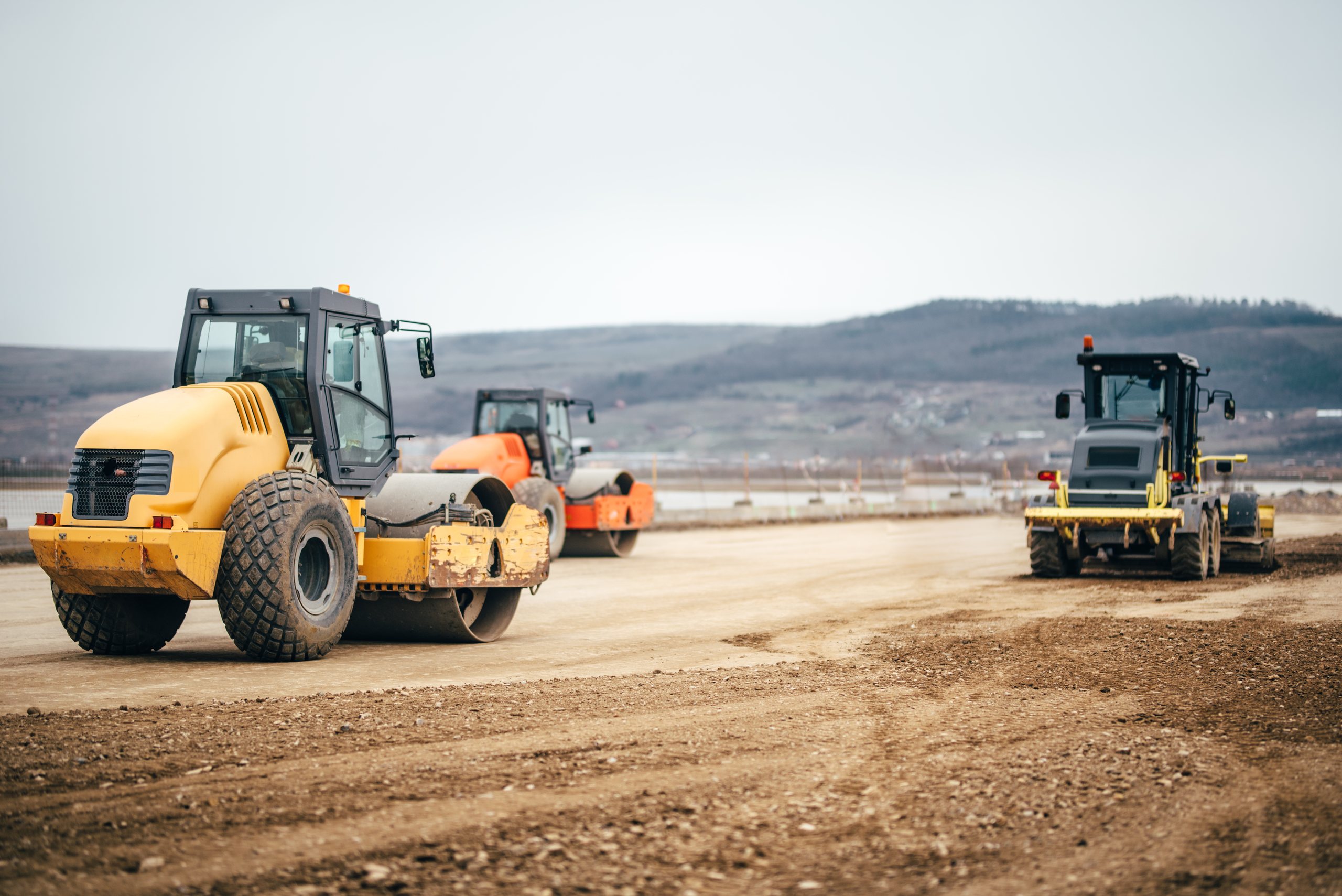
Real footage of construction, not drawings or renderings. 8 images and 4 short videos.
Footage from construction sites using the process. Videos have no sound and play only on click.
Where it works.
Where it doesn’t.
The process has been used on a wide range of soils. It has limits, and we state them up front.
Used on
- Sand
- Desert sand
- Loam
- Heavy clay
- Lateritic soil
Requirements
- The subgrade achieves at least 45 MN/m² in the plate load test.
- Organic content of the soil no more than 3%.
- Salt content of the soil no more than 3%.
- Mixing water with a hardness of no more than 500 ppm.
- A surfacing is always required.
Not suitable
- Sulphate-bearing soils. Tested in advance if suspected.
- Strongly acidic soils.
- Groundwater within the mixing depth.
- Frozen formation.
A suitability test on a sample of your soil shows whether it will work.
Get in touchWhat stays
in the soil.
Four facts, each with its source. Select one to see it in the drawing.
Swipe sideways for the second part of the drawing
Wax and water.
UNDERBOLD-POD30 is a solvent-free wax emulsion: approx. 30% wax and emulsifier, approx. 70% water. According to the safety data sheet, it is not classified as hazardous and is not dangerous goods; water hazard class 1 (WGK 1).Safety data sheet
Laboratory-tested.
In 2023, an accredited laboratory analysed the eluate from two test specimens of the bound layer. All heavy metals measured were below the limit values.
Eluate test 2023 · Limit values for landfill type B (Switzerland) · Test specimens with 0.40 l/m² and 3% cement
Stays on site.
The in-situ soil itself becomes the base course. Where the soil is suitable, this involves no excavation, no haulage and no imported material.
How the process works
Mineralogically tested.
In 2026, a university institute carried out a mineralogical analysis of two stabilised soil samples. Result: from a mineralogical point of view, no restriction on the further use of the soil.
Expert report 2026 · qualitative, on two samples prepared by us
What you can verify.
We draw a clear line between what is available today, what we provide under an NDA and what is only produced from your soil.
 Trial section 2011Bearing capacity measured
Available now
- Safety data sheet in German and Turkish
- Technical data sheet
- Compression test reports
Under NDA
- IP documentation with number and legal status
- Test report from the accredited construction testing body, with report number
- Management system certificates with registration number
- Declaration of origin and proof of authorisation
Produced from your soil sample
- Suitability test and dosage calculation for your soil
- Test report from an accredited laboratory, issued in your name
Measured after constructionPlate load test, degree of compaction, cores, compressive and indirect tensile strength after 7 and 28 days.
We supply the input value.
You do the calculation.
Common
questions.
How is the product supplied and stored?
As a concentrate in a 25-litre canister, 200-litre drum or 1,000-litre IBC. It is stored frost-free at +5 to +35 °C. According to the safety data sheet, the concentrate has a shelf life of six months.
How is it dosed?
At least 0.40 l of concentrate per square metre at 40 cm depth, usually mixed with water in the tank at a ratio of 1 to 50; the amount of water depends on the soil moisture content. Then 3% cement, no more than 5%. No more than 60 minutes may pass between
Does the base course need a surfacing?
Yes, always. Which one depends on use and loading. The pavement structure comparison on this page assumes 4 to 8 cm of asphalt, with gravel surfacing as an alternative.
How is bearing capacity verified?
With a plate load test on the finished layer, plus cores and compressive strength after 7 and 28 days. On a trial section on sand, stabilised to a depth of 40 cm, an external testing body measured a deformation modulus Ev2 of 296 MN/m² one day after construction (3% cement).
How does the layer behave in frost?
On cores from a completed road, the mass loss after freeze–thaw cycles was 3.1%. The limit value for the test was 10%.
How long is the track record?
The process has been in use for over 20 years. On a heavy-duty access road carrying an average of 80 heavy goods vehicles (HGVs) a day, no rehabilitation of the base course was needed after around six years, according to the client’s statement. An inter-urban road built in 2008 is holding up: the contractor that built it confirmed a good result in service after eight years and no settlement of the road foundation after around eleven.
Your soil.
Your project.
Send us your project data. We check suitability and recommend the right pavement structure.