
DE EN TR
Contact

Resources

What lies behind
the figures.

Evidence for every figure, all projects in detail and the videos on the process.

01Evidence

Every figure.
Its basis.

The nine key figures from the Benefits page. For each one: what it is based on, what it applies to and how it is determined for your project.

Fact sheetAs of November 2026

up to 40% savings
Basis
Guide valueUpper limit, not a guarantee
Applies to
Comparison with a conventional pavement structure including soil replacement
On your project
Cost estimate with your quantities and transport distances

Derivation

10 vs 2 days · up to 5 times faster
Basis
Illustrative example
Applies to
1 km road section, width not specified
On your project
Construction programme by area and plant

Derivation

16 vs 6 people
Basis
Illustrative example
Applies to
per kilometre, plant operators not listed separately
On your project
Crew planning by the contractor carrying out the works

Derivation

66–90 vs 46–50 cm pavement structure
Basis
Guide values
Applies to
Indicative pavement structure, not assigned to a traffic load class
On your project
Pavement design based on soil, frost and traffic

Derivation

296 MN/m² deformation modulus
Basis
Test reportexternal testing body, 2011
Applies to
Trial section on sand, 40 cm, day 1; cement content 3% according to the client
On your project
Plate load test on your area

Measured values

72 hours to full trafficability
Basis
Based on experience
Applies to
the fully compacted base course
On your project
Opening to traffic after measurement on your area

Measured values

3.1% mass loss in frost
Basis
Test reporttechnical approval, Romania, 2020 to 2023
Applies to
Cores from a completed road
On your project
Suitability test on your soil sample

Measured values

4.59 N/mm² compressive strength
Basis
Test reporttechnical approval, Romania, 2020 to 2023
Applies to
Cores from the same road after 28 days
On your project
Cores after 7 and 28 days

Measured values

up to 74% less CO₂
Basis
Model calculation
Applies to
1 km of rural road vs removal and rebuild; vs in-situ cement-bound base, up to 33% less
On your project
Footprint with your quantities and transport distances

CO₂ model calculation

Which documents we provide

In detail

ASavings and construction timeFour levers, what is added, what the figure applies to
  1. AMaterial

    66–90 to 46–50 cm

    The pavement above formation level becomes thinner. 40 cm of it is made from the existing soil and does not have to be brought in.

    Pavements compared, layer by layer

  2. BTransport

    • Excavation
    • Haulage
    • Imported material

    3 to 0 items

    Where the soil is suitable, nothing is excavated or hauled away for the base course, and no crushed stone is hauled in as a replacement. Cement and concentrate are delivered.

    How the process works

  3. CStaff

    16 to 6 people

    Per kilometre. With no excavation, haulage or imported material, the crews for them are not needed either.

    Illustrative example

  4. DConstruction time

    10 to 2 days

    For one kilometre of road. This gives ‘up to 5 times faster’.

    Illustrative example

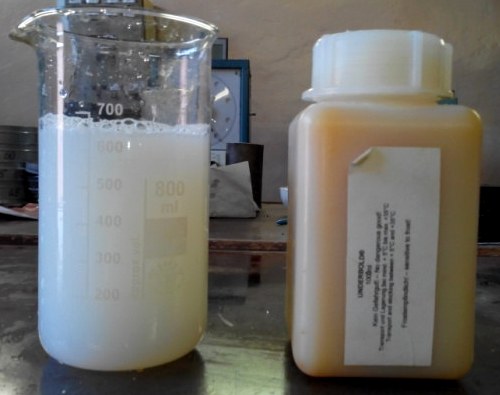
A beaker of milky white, diluted emulsion next to a bottle of amber concentrate
Left: diluted with water; right: the concentrate. Image from a testing laboratory.

What is added

  • UNDERBOLD-POD30at least 0.40 l of concentrate per m²
  • Cement3 to 5%, in a separate pass
  • Machine trainStabiliser with dosing system, cement spreader, grader, roller

What the figure applies to

The figure shows what is achievable. It is not a guarantee. The savings arise where soil would otherwise be replaced. Where only a thin base course is laid anyway, they are smaller.

Calculate quantities for your road

BThe measured valuesThree tests, from day one to year eleven

Three tests on completed areas, each next to its requirement. The measurements were taken by external testing bodies, not by us.

  1. Bearing capacity · Deformation modulus Ev2

    296 MN/m²

    Plate load test on a trial section, one day after construction. For comparison: for unbound base courses under heavy traffic, the test report gives 180 MN/m².

    0higher is better →

    What this meansThe value shows how little the layer yields under weight. The higher it is, the better the layer spreads the load of a heavy goods vehicle (HGV) onto the subgrade, and the less the road deforms.

  2. Frost · Mass loss after freeze–thaw cycles

    3.1%

    On cores from a completed road, tested for a technical approval.

    0← lower is better

    What this meansIn winter, the layer freezes through and thaws again. The test repeats this cycle many times on wet samples and then weighs how much material has scaled off. The less material lost, the better the layer withstands the winter.

  3. Strength · Compressive strength after 28 days

    4.59 N/mm²

    On cores from the same road. After 7 days, it was 3.82 N/mm².

    0N/mm²

    What this meansA core from the road is loaded in a compression machine until it breaks. The value shows how much pressure the layer can withstand before it gives way. It increases over time: after 28 days, the layer is stronger than after 7.

From day one to year eleven

  1. Day 1

    Bearing capacity measured: 296 MN/m² on the trial section.

  2. After 72 hours

    The base course is fully trafficable. The suitability test determines when the surfacing follows.

  3. Day 28

    Compressive strength tested on cores from a completed road: 4.59 N/mm².

  4. Year 6

    Heavy-duty access road with an average of 80 HGVs a day, no rehabilitation of the base course. Client’s statement.

  5. Year 11

    Inter-urban road from 2008: a good result in service after eight years, no settlement of the road foundation after around eleven years. Letter from the contractor.

Why water stays outWhere it works, where it doesn’t

CThe CO₂ model calculationTwo comparison cases, method and limits

The savings depend on the comparison. The model calculation for one kilometre of rural road covers two cases. Select one.

Conventional · removal and rebuild, 52 cm

100

UNDERBOLD-POD30 · 40 cm

26

−74%CO₂ compared with removal and rebuild of the base course

Model calculation for 1 km of two-lane rural road, approx. 10 m wide, based on data from contractors and our own values. In each case, only the base course is compared, not the entire pavement structure. The calculation covers plant operation and the production of cement and UNDERBOLD-POD30. The bars show the ratio, with the conventional case set at 100 each time. The system boundary and emission factors are not stated, and no independent review is available. For your project, what counts is the footprint based on your quantities and transport distances.

What stays in the soil: the four facts in detail

02Projects

Four questions
for 24 projects.

What a highway authority asks before approval.

01Will it hold up in frost, heat and heavy rain?

From 57° N to 27° S. Four climate zones.

60° N45° N30° N15° NEquator15° S30° SRiga 57° NTimbó 27° S
  • Cold winters 4
  • Temperate 12
  • Arid 5
  • Tropical 3

SourceKöppen–Geiger climate map; borderline locations such as Athens and Tabriz are assigned to the nearer zone.

FrostFrost test on cores: 3.1% loss, limit value 10%.

All locations and sources

SourceKöppen–Geiger climate map; borderline locations such as Athens and Tabriz are assigned to the nearer zone.

Next question: Soil

02Will it work with our soil?

Five soil types: sand, clay, loam, laterite, gravel.

SourceProject sheets; for Nuremberg the test report, for Kragujevac the geotechnical report. Laterite is a red tropical soil.

Your soilThe suitability test shows whether yours will work.

Locations and sources

SourceProject sheets; for Nuremberg the test report, for Kragujevac the geotechnical report. Laterite is a red tropical soil.

Next question: Loading

03Can it carry heavy traffic?

80 HGVs a day. Around six years without rehabilitation.

That is how many heavy goods vehicles (HGVs) use the access road in Timbó on average every day.

SourceClient’s statement for Timbó dated 20 February 2024; for the other projects, their use as stated in the project sheets.

Locations by use, with sources

SourceClient’s statement for Timbó dated 20 February 2024; for the other projects, their use as stated in the project sheets.

Next question: Age

04How long does it last?

No settlement after around eleven years. Confirmed in writing by the contractor.

around 11 yearsNovosibirsk · 2008 to 2019

8 yearsNovosibirsk · 2008 to 2016

around 6 yearsTimbó · 2017 to 2024

  • After around 11 years

    Novosibirsk · 2019: no settlement of the road foundation, no damage to the pavement structure.

  • After 8 years

    Novosibirsk · 2016: the road is holding up, with a good result in service.

  • After around 6 years

    Timbó · 2024: no rehabilitation of the base course needed.

  • Oldest projects

    Greater Athens and Istanbul, 2001.

SourceThree letters on two roads, from 2016, 2019 and 2024; we hold all of them.

Details and sources
  • After around 11 years

    Novosibirsk · 2019: no settlement of the road foundation, no damage to the pavement structure.

  • After 8 years

    Novosibirsk · 2016: the road is holding up, with a good result in service.

  • After around 6 years

    Timbó · 2024: no rehabilitation of the base course needed.

  • Oldest projects

    Greater Athens and Istanbul, 2001.

SourceThree letters on two roads, from 2016, 2019 and 2024; we hold all of them.

Quotes from the letters

Next question: Climate

Two roads,
three letters.

What the letters say about the condition of the roads, quoted directly.

  1. After 8 yearsNovosibirsk · 22 July 2016

    ‘This road section has shown a good result in service.’

    From the general director of the contractor that built the road.

    More about the letter

    ‘The […] gravel surfacing shows less settlement and deformation than where UNDERBOLD […] was not used.’

    Translated from Russian.

    SourceSigned letter with photos of the carriageway from July 2016.

  2. After around 11 yearsNovosibirsk · 7 June 2019

    ‘As at 7 June 2019, no settlement of the road foundation and no damage to the pavement were found. The road is in satisfactory condition.’

    The same contractor. ‘Satisfactory’ is a factual condition rating.

    More about the letter

    The confirmation gives the construction period as 2007 to 2008. Translated from Russian.

    SourceSigned written confirmation with photos from May 2019.

  3. After around 6 yearsTimbó · 20 February 2024

    ‘During this period, no rehabilitation of the base course was required in either the sloping or the level part of the section constructed.’

    From the director of the inter-municipal association that operates the facility.

    More about the letter

    ‘The road […] carries daily HGV traffic averaging 80 heavy vehicles.’

    Translated from Portuguese.

    SourceElectronically signed statement with photos.

A selection
of our projects.

24 examples from 16 countries, most recent first.

  • 2025Lenzburg, SwitzerlandCycle path
  • 2023Buchanan, LiberiaLink road
  • 2019Riga, LatviaUrban street
  • 2019Sozopol, BulgariaMunicipal road
  • 2019Teofipol, UkraineIndustrial access road
  • 2019Teofipol, UkraineUrban street
  • 2018St. Alban, GermanyWind turbine crane pad
  • 2017Timbó, BrazilHeavy-duty access road
  • 2016Al Ansab, OmanResidential street
  • 2016Kula Municipality, SerbiaFarm tracks
  • 2016Kragujevac, SerbiaMunicipal road
  • 2016Muscat, OmanHaul road
  • 2014Tabriz, IranBus lane
  • 2011Near Abuja, NigeriaTrunk road
  • 2011Nuremberg, GermanyTrial section
  • 2009Abia State, NigeriaMunicipal road
  • 2009Crailsheim, GermanyHGV access road
  • 2009Holzgerlingen, GermanyCar park
  • 2009–2010Manama, BahrainTrial section
  • 2009Manama, BahrainNew road construction
  • 2008Novosibirsk, RussiaInter-urban road
  • 2008Veľké Kosihy, SlovakiaMunicipal road
  • 2001Greater Athens, GreeceHeavy-duty access road
  • 2001Istanbul, TürkiyeSports ground access road

And many more.

Which documents we provide

03Media

The process
on video.

No video starts by itself. Each one plays only when you click it, with sound.

▶The process on video · 2:31 min · with sound

The five steps

  1. 01Working in UNDERBOLD
  2. 02Intermediate compaction
  3. 03Spreading cement
  4. 04Mixing in cement
  5. 05Shaping and compaction

The step videos are animations. Real footage of construction is in the gallery on the Underbold page.

On site: photos and videos

Your soil.
Your project.

Send us your project data. We check suitability and recommend the right pavement structure.

Reply within two working days

We only receive your details when you send the email, and we use them to reply. Privacy policy